Autonomous agents that check their own work
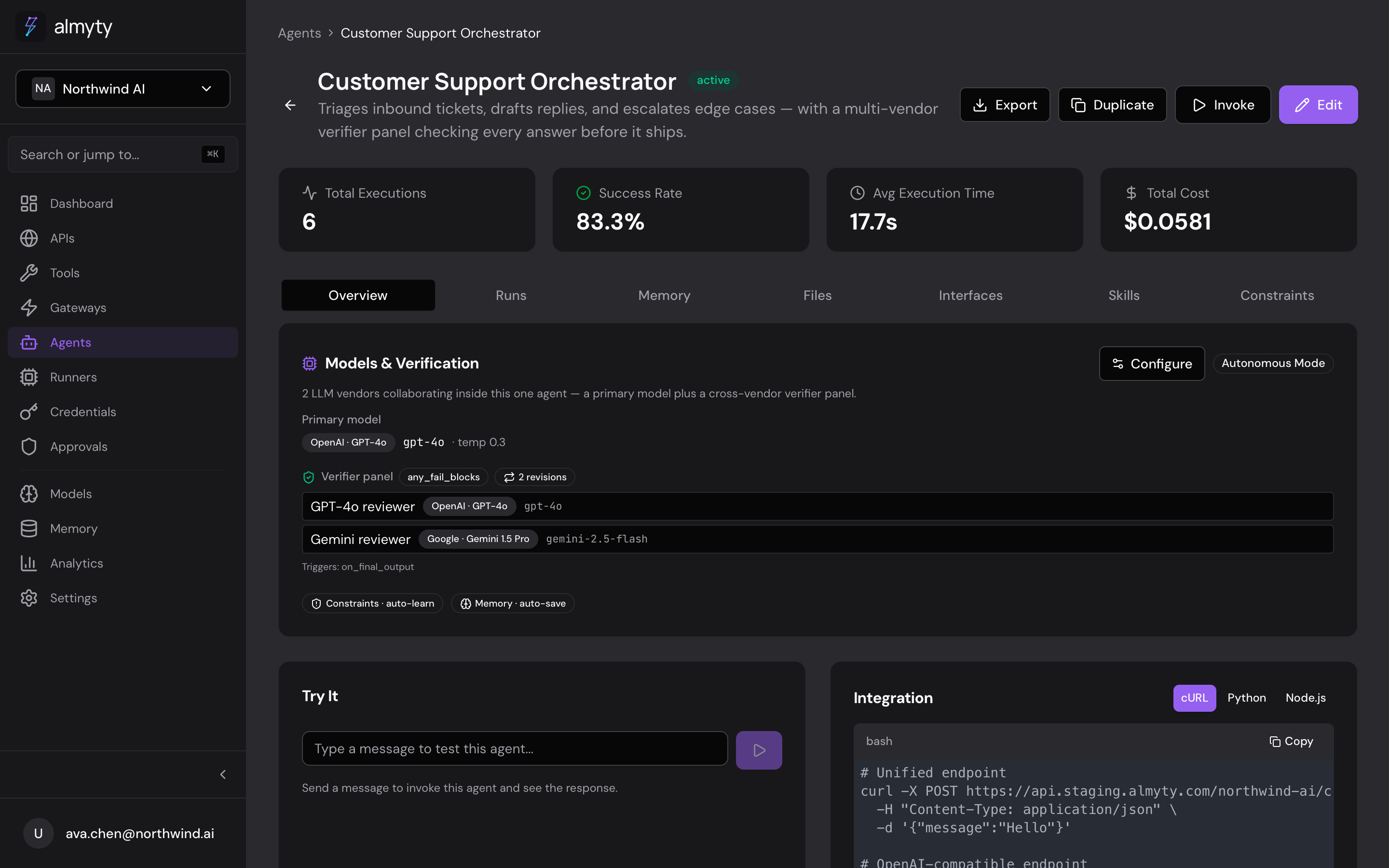
Give an agent instructions and tools and let it decide what to do — but not blindly. Several models collaborate inside one agent: a primary model acts, others verify before anything ships. It remembers across runs, refuses to repeat past mistakes, and turns its best runs into reusable skills.
Two modes
Autonomous when you want reasoning, workflow when you want control
Most jobs want an agent that figures out the steps. Some want a fixed pipeline you can read line by line. almyty does both, in the same product.
The model decides
Set instructions, attach tools, and the agent plans, calls tools, and composes an answer on its own. Several LLMs collaborate in one agent, output is verified before it ships, memory and constraints carry across runs, and strong runs become reusable skills.
You decide, exactly
When a task must run the same way every time, draw it as a graph: input, LLM call, tool call, condition, loop, parallel, merge, sub-agent. What runs is what you drew, validated before it ships.
Inside an autonomous agent
One agent, several models, real guardrails
Not a single prompt behind a chat box. An autonomous agent in almyty is a small system that reasons, checks itself, and gets better with use.
Multiple models in one agent
Run a fast model to act and stronger models to check, inside the same agent. Each role can use a different provider, your choice per agent.
Verify before it ships
A verification pass gates the final output, and can fire mid-run too, so a bad answer is caught and retried instead of returned.
Memory across runs
The agent keeps facts, preferences, and context between runs, so it stops relearning the same things every time.
Constraints from failures
When a run fails, the lesson becomes a constraint the agent must honor next time, so it does not repeat the same mistake.
Promote runs to skills
Turn a run that went well into a reusable skill the agent can reach for later, instead of re-deriving the steps from scratch.
Replay any run
Re-run a past execution to debug it or reproduce a result, with the full transcript of decisions and tool calls.
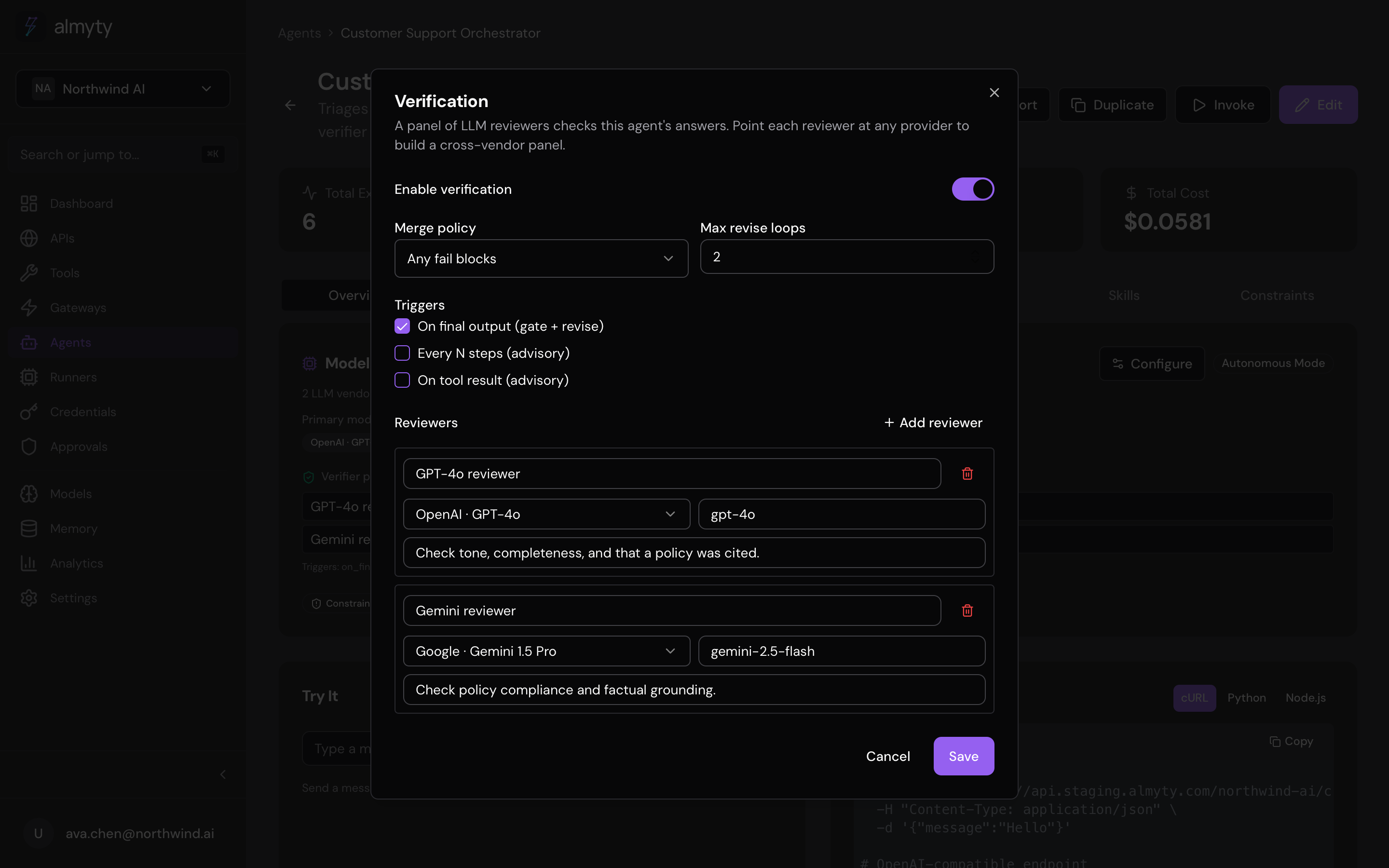
Set up the verifier panel in the UI: primary plus reviewer models, merge policy, triggers, and revise budget.
Collaboration modes
Many models, working as a team
When one model is not enough, point an agent at several and choose how they work together. Each member can be a different provider, and the judge that settles the result can be a different model again.
Sequential
Members run one after another, each fed the previous one's output — a chain where each model builds on the last.
Parallel
All members run at once on the same input. A judge model merges their answers into one, or they are returned together.
Race
All members run at once; the first to finish wins. You still see the full cost, so a budget cap holds across every racer.
Debate
Members argue over multiple rounds, each round seeing all prior responses. A judge model reads the debate and writes the final answer.
The judge is any agent you point it at, so a Claude debate can be settled by GPT-4o, or the other way around. Real and tested.
Call it like any model
However it is built, it answers on one endpoint
Autonomous or workflow, every agent is reachable through an OpenAI-compatible API. Point an existing SDK at it — change the base URL and the model name, keep the rest of your code.
# any OpenAI client works — just swap the base URL
curl https://api.almyty.com/agents/$ID/v1/chat/completions \
  -H "Authorization: Bearer $ALMYTY_TOKEN" \
  -H "Content-Type: application/json" \
  -d '{
    "model": "agent",
    "messages": [{"role":"user","content":"…"}]
  }'
Workflow mode
When you want a pipeline you can read
For deterministic, auditable work, build the agent as a graph. The same control-flow nodes you would otherwise hand-code, wired in a visual builder.
inputoutputllm_calltool_callconditiontransformloopparallelmergesub_agent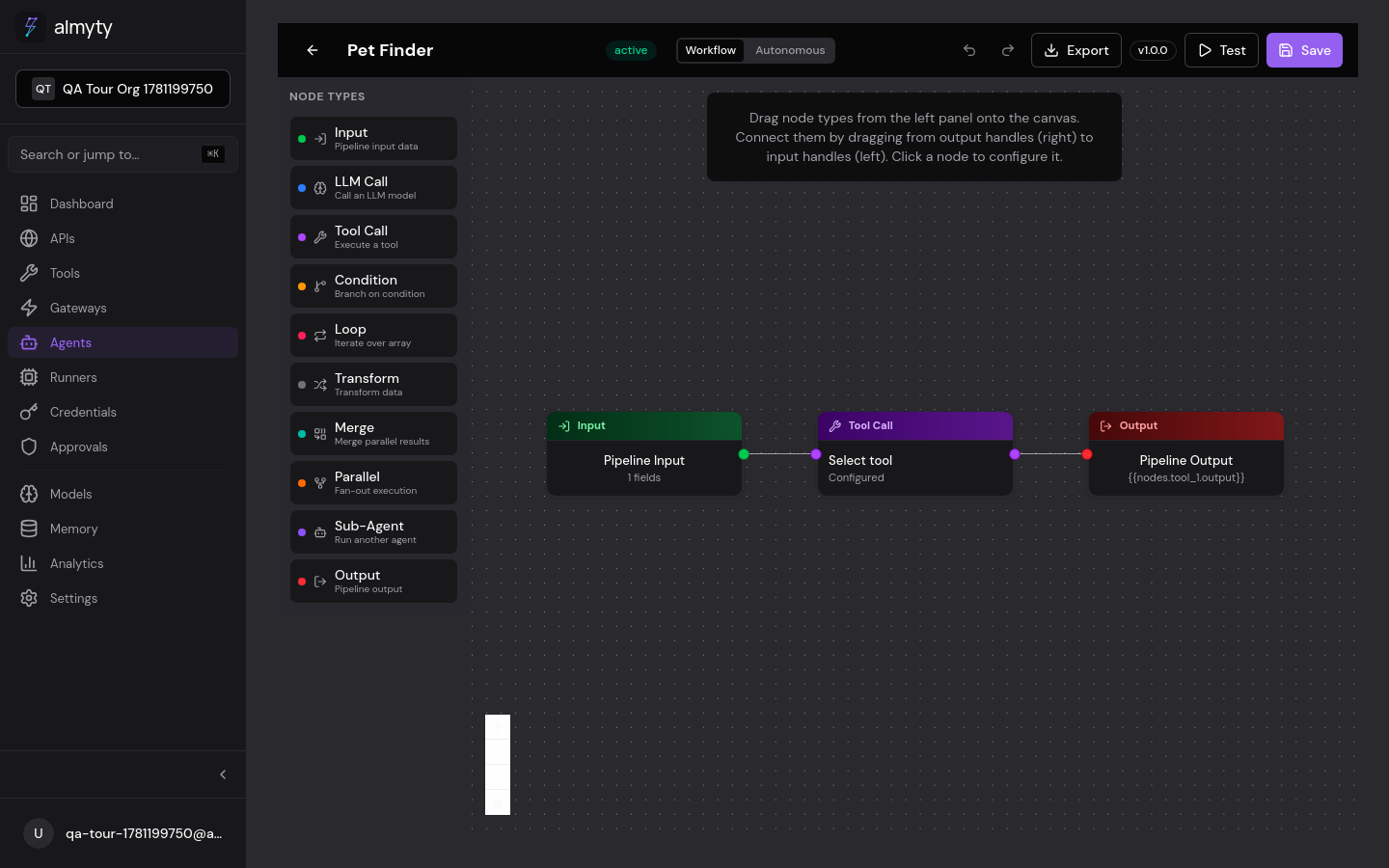
Branch on conditions
Route the run down different paths based on a tool result or an LLM decision, without leaving the graph.
Loop over data
Iterate a step across a list, with a guard so a run cannot spin forever.
Parallel and merge
Fan out independent calls, then merge their outputs back into one path.
Build your first agent
Start autonomous and let it reason, or draw a workflow when you need exact control. Connect an API first to give it tools to call.