What teams build with almyty
From giving Claude your own APIs to running governed autonomous agents in production. Each example maps to a feature that ships today.
Give Claude Code your own APIs
Engineering teams with internal or third-party APIs
The problem. Your AI assistant can write code, but it cannot call the services you actually run: orders, billing, that internal GraphQL API.
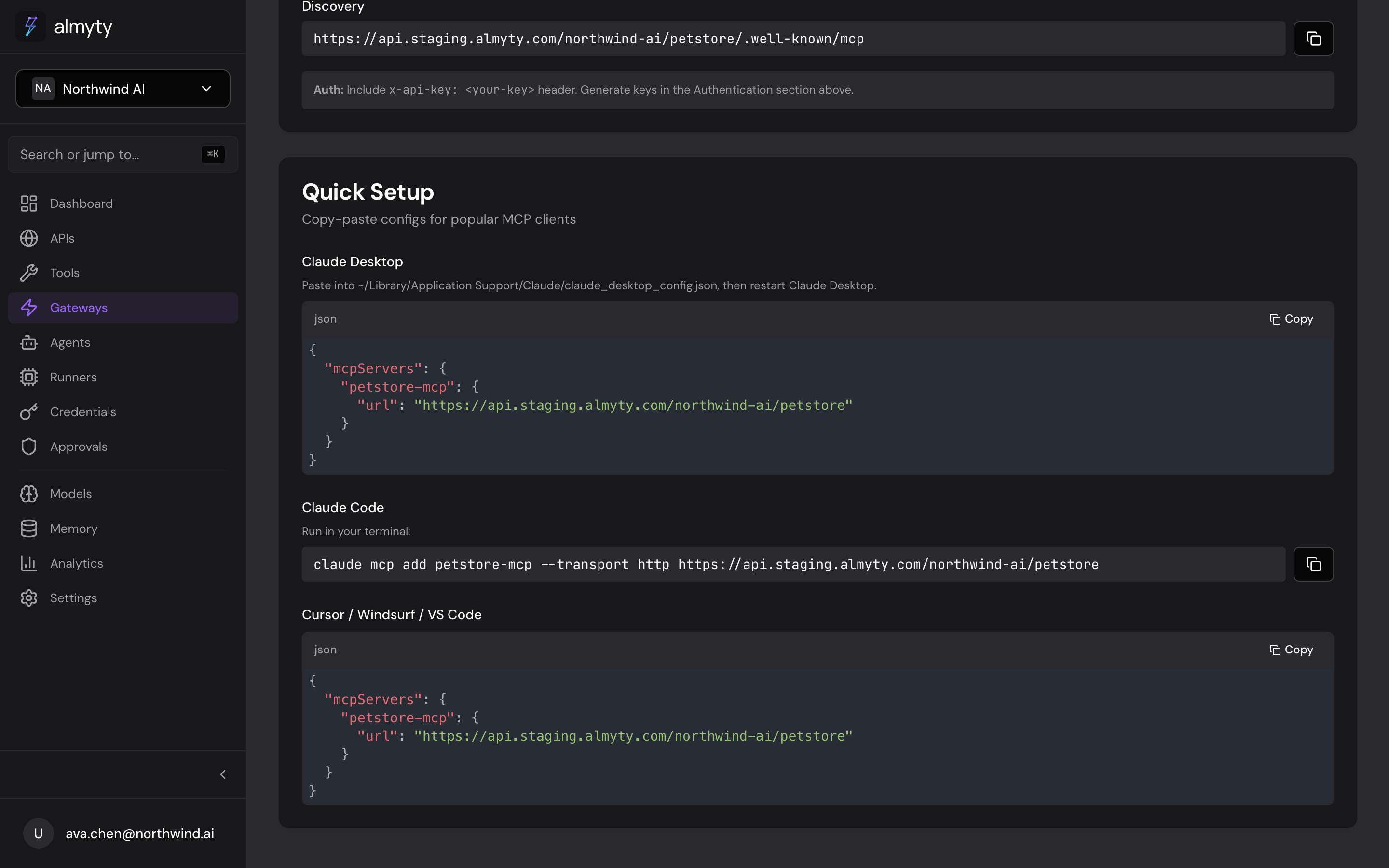
What you build. Point almyty at the schema (OpenAPI, GraphQL, SOAP, Protobuf). It generates a typed tool per operation, you publish an MCP gateway, and `claude mcp add` puts them in Claude Code, Cursor, or any MCP client.
A support agent that checks its own work
Support and operations teams
The problem. A single-model agent will confidently send a wrong answer, or promise a refund it should have escalated.
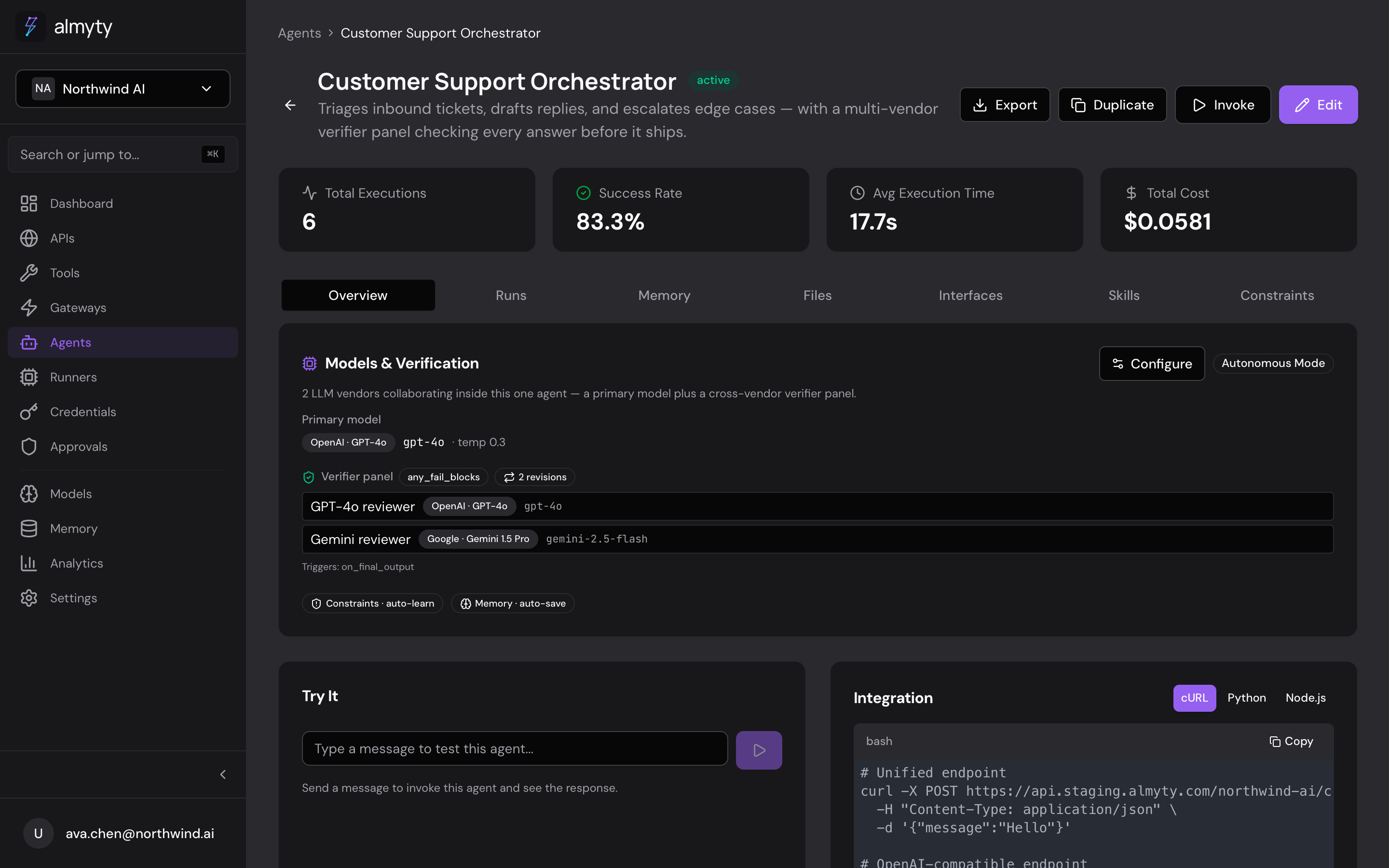
What you build. Build an autonomous agent where a primary model drafts, and reviewer models from other vendors verify before anything ships. Refunds over a threshold pause the run for a human via the approvals gate.
Orchestrate a multi-vendor coding fleet
Platform teams and power users
The problem. Every coding CLI is single-vendor: Claude Code on Anthropic, Codex on OpenAI, Gemini on Google. You cannot make them collaborate.
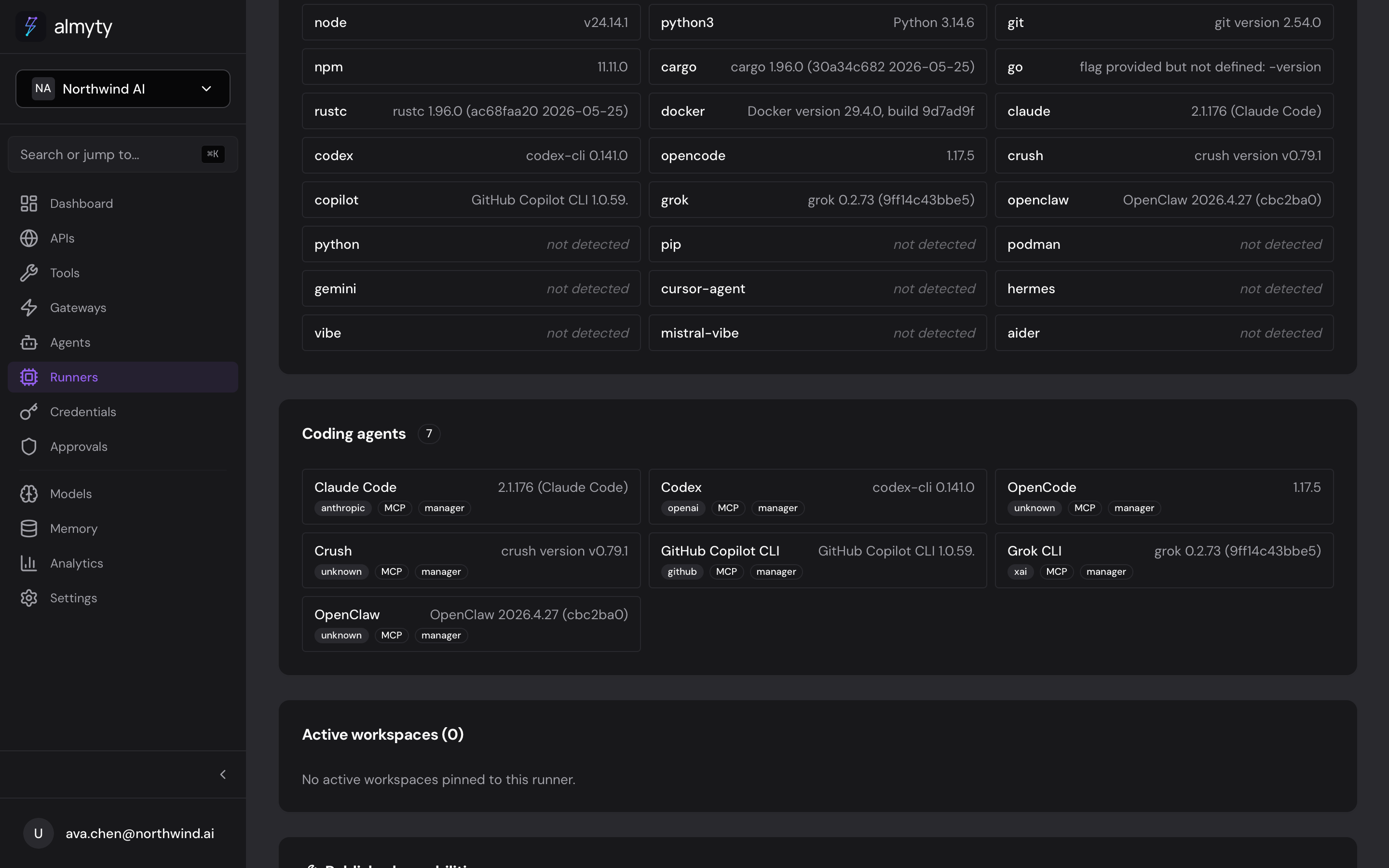
What you build. Run the almyty runner on your machine. It detects the coding CLIs you have and lets one agent drive several of them on the same codebase: a planner dispatching subtasks, each on a different model.
Turn a good run into a reusable skill
Teams standardizing on repeatable workflows
The problem. An agent solves a task well once, then re-derives the same steps from scratch on the next similar task.
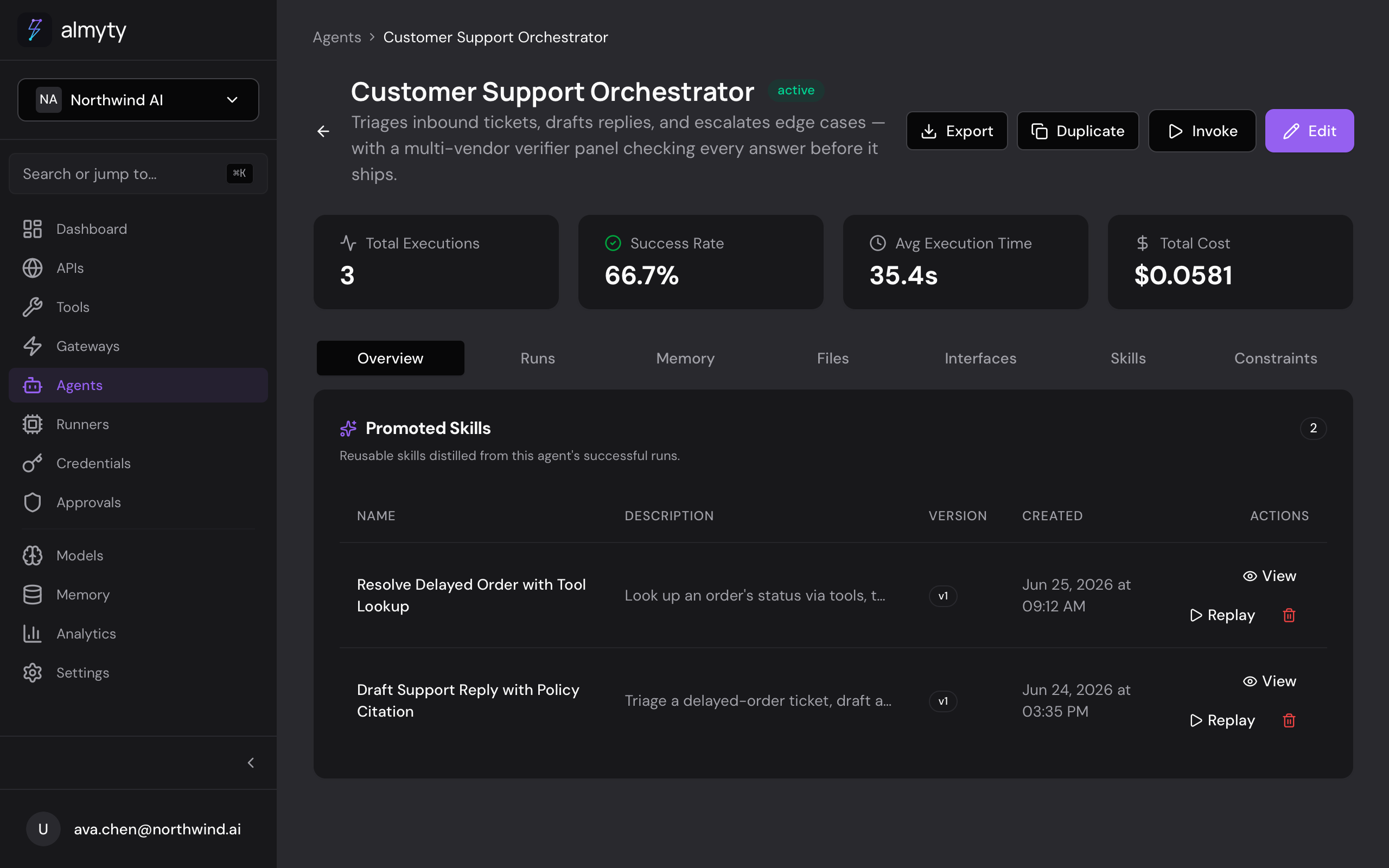
What you build. Promote a successful run to a skill. almyty distills it into an Agent Skills SKILL.md, versioned and served over MCP and REST, so the next agent, or your editor, calls it directly.
More to build
A few more, from the same building blocks
Every one of these uses the same core: tools, agents, gateways, the runner, composed differently.
Turn an npm package into tools
For developersPoint almyty at a package like stripe or @aws-sdk/client-s3. It installs it in a sandbox, reads the types, and generates a tool per function. No wrappers.
Multi-model debate for high-stakes calls
Autonomous agentsFor research, due diligence, or contract review, have several models debate over rounds and a judge settle the answer: Claude, GPT-4o, and Gemini in one agent.
Governed agents in production
EnterprisePut an agent in front of people with verify gates, human approvals (Business), a PII-filter plugin, RBAC, and an audit log.
Air-gapped, self-hosted agents
EnterpriseSelf-host almyty and run open-source models (Ollama) so nothing leaves your network, for data residency and offline environments.
Have a use case in mind?
Start from an API you already run, or an agent you want to build. The pieces are the same either way.